
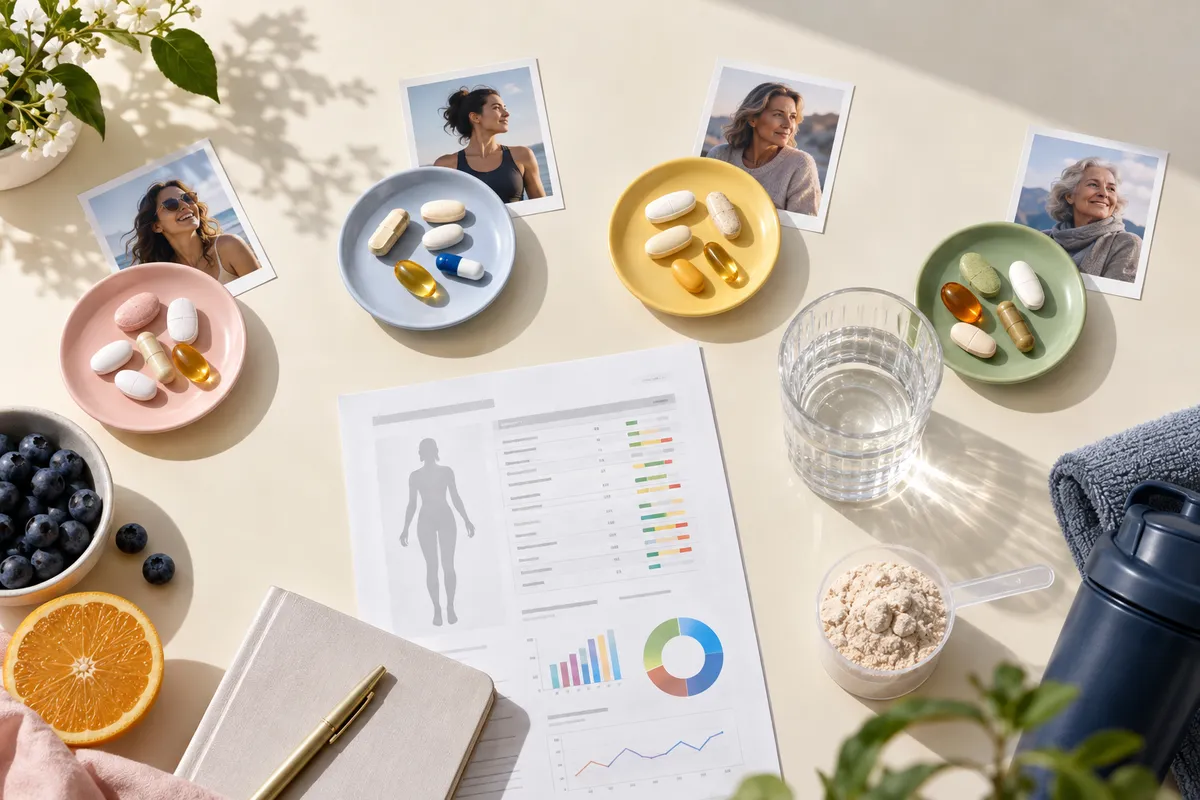
Women's Health has published an expert-sourced guide to the supplements women may want in each decade of life, running from the 20s through the 60s and beyond. The pieces moving around the board: bone health, hormones, fertility, heart health, muscle mass and cognition. The throughline is that your nutrient needs change as you age.
This is a wellness piece, so no shade here, just a useful lens. Think of your supplement shelf like a wardrobe: the staples stay, a few pieces rotate in and out, and nobody needs every trend at once. (That's my analogy, not the outlet's.)
The Rule Before the Roadmap
Per Women's Health, the guide stresses checking with a doctor first, considering bloodwork, and treating supplements as support rather than a replacement for food and lifestyle. Consider that the lining under everything below. A shelf full of capsules is not a strategy.
20s and 30s: Foundations and Fertility
The guide lists vitamin D, prenatal vitamins, iron, calcium, vitamin B12 and magnesium for this stretch. The mix reads like a blend of building blocks (bones, energy) and planning ahead (prenatals, relevant if pregnancy is on your radar). I'd read the prenatal entry as tied to fertility and pregnancy planning, which the guide flags as a theme of these decades, rather than as a universal must-have.
40s: The Pivot Decade
The 40s list shifts. Omega-3s and vitamin K arrive, while calcium, vitamin B12 and magnesium stay on. Prenatal also appears again, a reminder that plenty of women are still thinking about pregnancy in this decade.
It's hard not to notice that this is where heart health and bone protection start appearing as headline concerns, which tracks with the wider conversation around perimenopause. The guide frames these decades around those changing needs.
50s: The Longest List
The 50s get the most entries in the roundup: choline, multivitamins, magnesium, vitamin D, calcium, omega-3s and vitamin B12. Choline is the new face in the lineup, and a rare one that doesn't repeat from earlier decades.
My take: a long list is a reason for a conversation with your doctor, not a reason to buy seven bottles tomorrow. If the guide's own advice is to consider bloodwork, a 50s routine is exactly where it pays off.
60s and Up: Muscle, Heart and Mind
For this group, the guide names vitamin D, protein supplements, CoQ10, creatine, vitamin B12 and magnesium. Per the outlet, there are five more items beyond the ones I've listed here that the full piece covers, so for the complete rundown you'll want to read the original.
Creatine and protein are the interesting pair. Both are gym-world staples, and their appearance here lines up with the piece's emphasis on muscle preservation. Strength training's glow-up from bodybuilder niche to longevity essential is a pop-culture arc worth watching, though I'm drawing that connection myself.
The Repeat Offenders
Scan the whole list and a few names keep showing up: vitamin D, magnesium, calcium and vitamin B12 appear across multiple decades. That's my observation from the lists, not a medical claim. It does suggest that the biggest changes between decades may be the add-ons, not the basics.
What to Do With This
- Ask about bloodwork. The guide encourages it, and it turns guesswork into data.
- Talk to your doctor before starting anything, especially if you take medications or are trying to conceive.
- Keep food first. Supplements are support, per the guide, not a substitute.
The Takeaway
Wellness culture loves a universal stack: one powder, one gummy, one routine for everyone. The most sensible message in Women's Health's roundup is the opposite one. Your needs shift, so your shelf should too, and the best accessory to any supplement plan is a doctor who has seen your lab results.